
Exploring the Relationship Between Functional Assessments and X-Rays in Patient Care
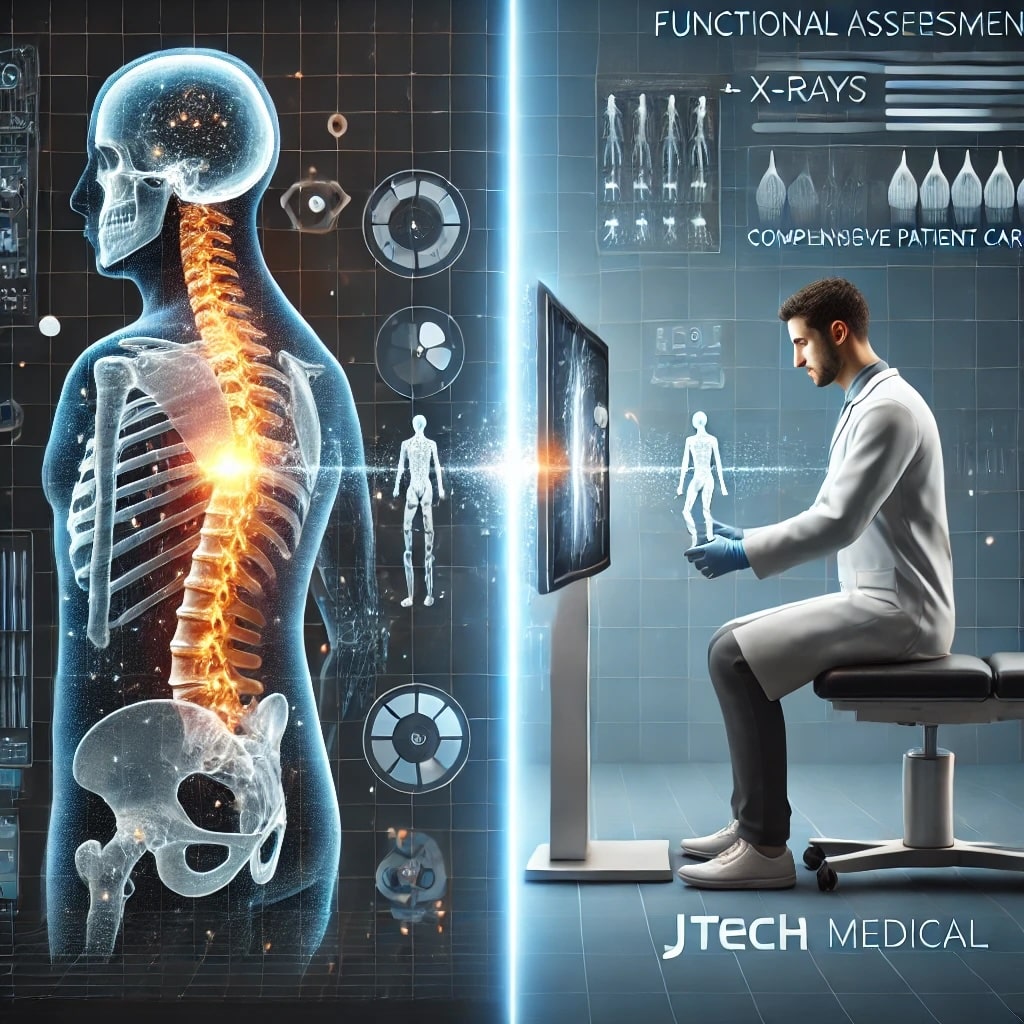
Combine Inclinometers, Muscle Strength, Grip Strength, Pinch Strength, Static Force Gauge, Algometer, Goniometer, ie. functional assessments and X-rays, for maximum understanding of the situation.
In modern healthcare, accurate diagnosis and effective treatment plans rely on a combination of clinical assessments and diagnostic imaging. For professionals in chiropractic care, physical therapy, occupational medicine, and sports medicine, two key tools in this process are functional assessments and X-rays. At JTECH Medical, we are committed to enhancing both through innovative functional assessment technology.
What Are Functional Assessments?
Functional assessments measure a patient’s ability to perform specific physical tasks and evaluate key factors such as range of motion (ROM), muscle strength, and flexibility. By using objective data gathered through tools like JTECH’s Commander Echo or Northstar systems, clinicians gain insights into a patient’s functional abilities and limitations. This information is vital for creating customized treatment plans that optimize recovery and prevent re-injury.
The Role of X-Rays in Patient Diagnosis
X-rays are a crucial diagnostic imaging tool that provides visual evidence of structural issues in the body. According to the American College of Radiology, X-rays reveal fractures, joint degeneration, misalignments, and other internal abnormalities. While X-rays offer a snapshot of internal structure, they do not always provide information on how well those structures function in real-world movements and tasks. This is where functional assessments complement X-rays.
Why Functional Assessments and X-Rays Work Together
- Comprehensive Diagnosis:
X-rays help identify structural damage, but functional assessments reveal how those structural changes impact a patient’s ability to move and perform daily activities. For example, an X-ray may show spinal misalignment, but a range-of-motion test can demonstrate how that misalignment limits flexibility or causes pain during movement. - Better Treatment Planning:
Combining these tools allows clinicians to develop more targeted treatment plans. An X-ray can identify where structural corrections may be needed, while functional testing helps prioritize therapy that restores movement and strength. - Monitoring Progress:
Functional assessments offer measurable benchmarks to track improvements over time. Regularly testing a patient’s range of motion, muscle strength, and flexibility provides data-driven evidence of progress. Imaging, on the other hand, can track structural changes but may not show improvements in functionality. - Supporting Insurance Claims and Legal Cases:
In personal injury and workers’ compensation cases, combining both types of data can strengthen documentation. Objective evidence paired with imaging results supports accurate diagnosis, prognosis, and treatment justifications for insurance companies and legal entities. The AMA Guides support this kind of objective, measurable evidence in impairment ratings.
Case Example: Enhancing Care in Personal Injury Clinics
Consider a patient who presents with back pain following a car accident. An X-ray may reveal a slight vertebral fracture, but this alone doesn’t explain the extent of the patient’s pain or their limitations in mobility. By conducting a functional assessment, the provider identifies significant restrictions in range of motion and weakness in the lumbar region. This additional data informs the treatment plan, emphasizing both structural healing and functional rehabilitation.
The Future of Integrated Diagnostics
At JTECH Medical, we believe in advancing tools that empower healthcare professionals to provide comprehensive care. Our functional assessment systems are designed to seamlessly integrate with diagnostic imaging insights, enabling clinicians to deliver better outcomes for patients. As healthcare continues to embrace data-driven solutions, the relationship between these complementary tools will remain essential to improving both diagnosis and recovery.
By combining these two methods, clinicians can achieve a fuller understanding of each patient’s condition, helping them to provide more effective, personalized care. Whether you’re focused on personal injury, occupational medicine, or physical rehabilitation, leveraging both methods will continue to be a best practice in modern healthcare.
Frequently Asked Questions
How do functional assessments and X-rays differ?
X-rays show static structural anatomy such as bones, joints, and alignment, while functional assessments measure how a patient actually moves, including range of motion, muscle strength, and flexibility. Used together, they provide both structural and performance data.
Which clinicians benefit most from combining the two?
Chiropractors, physical therapists, occupational medicine providers, and sports medicine clinicians benefit most. Personal injury and workers’ compensation practices especially benefit from the combined objective documentation.
What tools does JTECH offer for functional assessment?
JTECH Medical offers the Commander Echo and Northstar systems, including inclinometers, dynamometers, algometers, and goniometers, designed to capture objective, repeatable measurements that pair seamlessly with imaging data.