
Handheld Dynamometers/Grip Strength Testers: What You Need To Know
Key Takeaways:
- A handheld dynamometer replaces subjective manual muscle testing with objective, quantified force data.
- Digital handheld dynamometers improve reliability, reduce inter-rater error, and support defensible documentation.
- Quantified strength data is essential for impairment ratings, return-to-work decisions, and tracking chronic pain recovery.
- JTECH’s grip strength testers integrate directly with reporting software for AMA-compliant outputs.
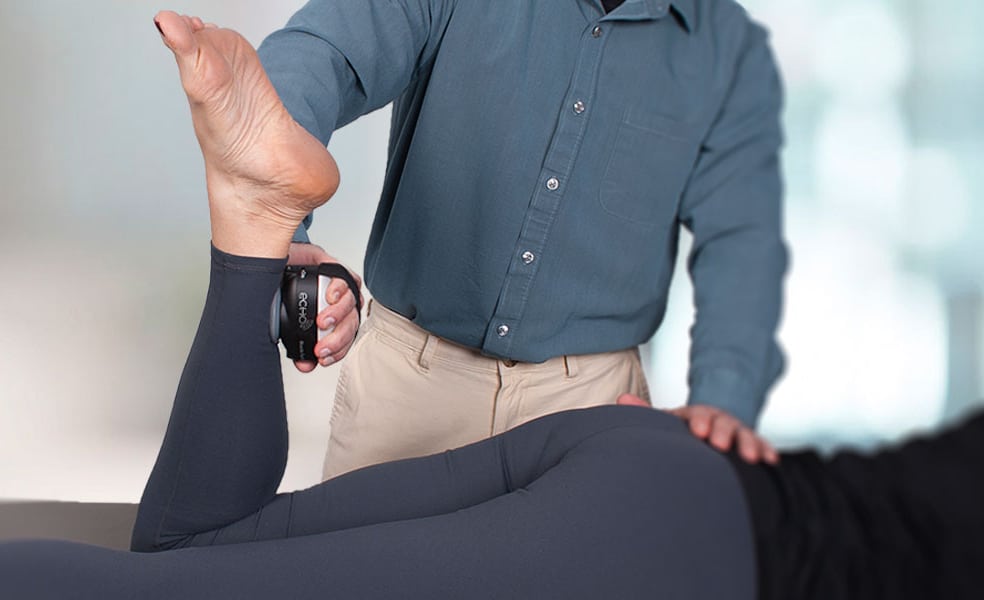
A handheld dynamometer is a portable, digital force-measurement device that has become the clinical standard for evaluating muscle strength. For many years, the medical world relied on manual muscle testing to evaluate motor impairments. Various manual range-of-motion testing methods have been developed to estimate a patient’s strength, but manual methods have a high potential to produce false impairment readings and poor evaluations.
Because manual treatmentsrely on different standards, techniques, and examiner-dependent judgment, their results are inherently subjective. The tools replacing manual methods — led by the handheld dynamometer — provide a level of accuracy far superior to their manual counterparts.
Handheld Dynamometers vs. Manual Muscle Testing
Currently, one of the most powerful tools replacing manual muscle testing devices is the handheld dynamometer. Using manual methods, a clinician may ask the patient to push against their hand and then subjectively judge whether the force generated is normal.
A grip strength tester, however, captures the force a patient generates through a load-cell transducer, quantifies it in pounds or kilograms, and presents the data in a digital format. Clinicians can use this muscle strength testing equipment to measure strength efficiently and reproducibly across the board. Reducing variability and increasing reliability gives providers the best information to evaluate each patient.
Why Manual Muscle Testing Falls Short
- Subjective 0–5 grading scale with poor inter-rater reliability
- Cannot detect small but clinically meaningful changes between visits
- Difficult to defend in workers’ compensation, IME, or legal review
- No exportable data record for chart, EMR, or report
Equipment Advancements: How a Handheld Dynamometer Works
Although listening for heart irregularities without a stethoscope is not impossible, the proper tools make the process much easier and far more accurate. The same is true for muscle assessment and the use of range-of-motion testing solutions. Manual methods simply cannot compare to the accuracy a handheld dynamometer provides.
Many clinical studies have found that the additional consistency provided by a computerized grip strength tester is essential to delivering the most effective treatment. By measuring muscle strength with consistency, providers can track progress over time, giving a more accurate sense of improvement — particularly for the treatment of chronic pain. Chronic back pain, for example, is defined as pain that persists for 12 weeks or longer. A digital grip strength tester allows for consistent, comparable measurements across these weeks and months of care.
Clinical Uses for a Handheld Dynamometer
- Impairment ratings — defensible strength data for AMA Guides evaluations
- Functional capacity evaluations (FCE) — quantified output for return-to-work decisions
- Pre-employment screening — baseline strength to match physical job demands
- Rehabilitation progress tracking — repeatable measurements visit-to-visit
- Sports medicine and orthopedics — return-to-play and post-op recovery benchmarks
What to Look for in a Handheld Dynamometer
- Calibrated load-cell accuracy with traceable certification
- Digital data capture and exportable reports
- Software integration with EMR or measurement platforms such as Northstar
- Coefficient of variation (CV) analysis for sincerity-of-effort testing
- Ergonomic design and rechargeable battery life
Frequently Asked Questions About Handheld Dynamometers
What is a Grip Strength Tester used for?
A grip strength tester is used to objectively measure muscle strength during clinical assessments, impairment ratings, functional capacity evaluations, return-to-work testing, and rehabilitation progress tracking.
Is a handheld dynamometer more accurate than manual muscle testing?
Yes. A calibrated handheld dynamometer produces quantified force data with significantly higher inter-rater reliability than the subjective 0–5 manual muscle testing scale.
Can a handheld dynamometer measure sincerity of effort?
Yes. By collecting multiple trials and analyzing coefficient of variation (CV), a handheld dynamometer can document maximal voluntary effort — a critical requirement under AMA Guides protocols.
How often should a Grip Strength Tester be calibrated?
Most manufacturers recommend annual calibration verification, with periodic in-house checks against a known reference weight to confirm ongoing accuracy.
The Bottom Line on Handheld Dynamometers
Medical professionals ultimately need one essential element to effectively evaluate and treat their patient: accuracy. A handheld dynamometer provides a level of reliability, consistency, and accuracy that manual methods simply cannot match. Pairing impartial digital data with professional clinical expertise gives patients the best chance to reach their greatest physical abilities.
Ready to upgrade your muscle testing workflow? Explore JTECH’s digital handheld dynamometers or contact JTECH Medical for a demo of dynamometry and other digital muscle testing equipment.