
Objective Progress Tracking Improves Rehabilitation Outcomes
Objective progress tracking is the single most reliable way to prove that rehabilitation is working — for patients, clinicians, and payers alike. By replacing vague impressions with calibrated, repeatable measurements, objective progress tracking turns every visit into defensible, reimbursable evidence of recovery. Practices that adopt structured objective progress tracking with tools like Commander Echo consistently report faster authorizations, fewer denials, and stronger clinical outcomes.
The Problem With Subjective Progress Reports
In rehabilitation, the question “how is the patient doing?” comes up constantly — from referring physicians, insurance adjusters, case managers, and the patients themselves. Too often, the answer relies on vague language: “improving,” “tolerating treatment well,” or “reports less pain.” These subjective descriptions may satisfy a quick conversation, but they fall short when it comes to clinical decision-making, insurance justification, or legal documentation.
The core issue is that subjective reports do not give anyone a clear, comparable picture of where the patient started, where they are now, and how much further they need to go. Without measurable data, clinicians risk making treatment adjustments based on impressions rather than evidence, and insurers are more likely to deny continued care when the documentation cannot demonstrate meaningful progress.
What Objective Progress Tracking Looks Like
Objective progress tracking means collecting quantifiable measurements at regular intervals throughout a course of rehabilitation. Instead of noting that a patient “has better shoulder mobility,” the clinician records that active shoulder flexion improved from 95 degrees at intake to 140 degrees at the six-week mark — a 47% improvement toward the functional goal of 160 degrees.
The most commonly tracked objective measures in rehabilitation include:
- Range of motion — measured with inclinometers or goniometers at each joint, tracked from baseline through discharge
- Muscle strength — assessed with dynamometers for grip, pinch, and individual muscle groups, providing force values in pounds or kilograms
- Pain thresholds — quantified with algometers that measure the exact pressure at which a patient reports pain, removing the subjectivity of a 0-to-10 scale
- Functional performance — standardized tests like the Timed Up and Go (TUG), Berg Balance Scale, or 6-Minute Walk Test that produce repeatable scores
- Patient-reported outcomes — validated questionnaires such as the DASH, Oswestry Disability Index, or SF-36 that convert subjective experience into standardized scores
When these measurements are collected consistently, they create a data trail that tells a clear story: baseline impairment, rate of recovery, response to specific interventions, and remaining deficits.
Better Data Drives Better Clinical Decisions
Rehabilitation is not a one-size-fits-all process. Two patients with the same diagnosis can respond to treatment in completely different ways. Objective data gives clinicians the feedback loop they need to adjust treatment in real time rather than waiting weeks to realize an approach is not working.
For example, if a patient’s grip strength has plateaued for three consecutive sessions despite progressive resistance training, the data signals that a change is needed — perhaps a different exercise, a change in frequency, or a referral for further evaluation. Without objective measurements, that plateau might go unnoticed until the patient or insurer raises a concern.
Research published in PLOS One found that physical therapists who consistently use standardized outcome measures report better ability to identify treatment plateaus early and modify interventions accordingly. The data does not replace clinical judgment — it sharpens it.
Motivating Patients With Visible Progress
One of the most underappreciated benefits of objective tracking is its impact on patient motivation. Rehabilitation can be slow, frustrating work. Patients often feel like they are not making progress even when they are, simply because day-to-day changes are too small to notice.
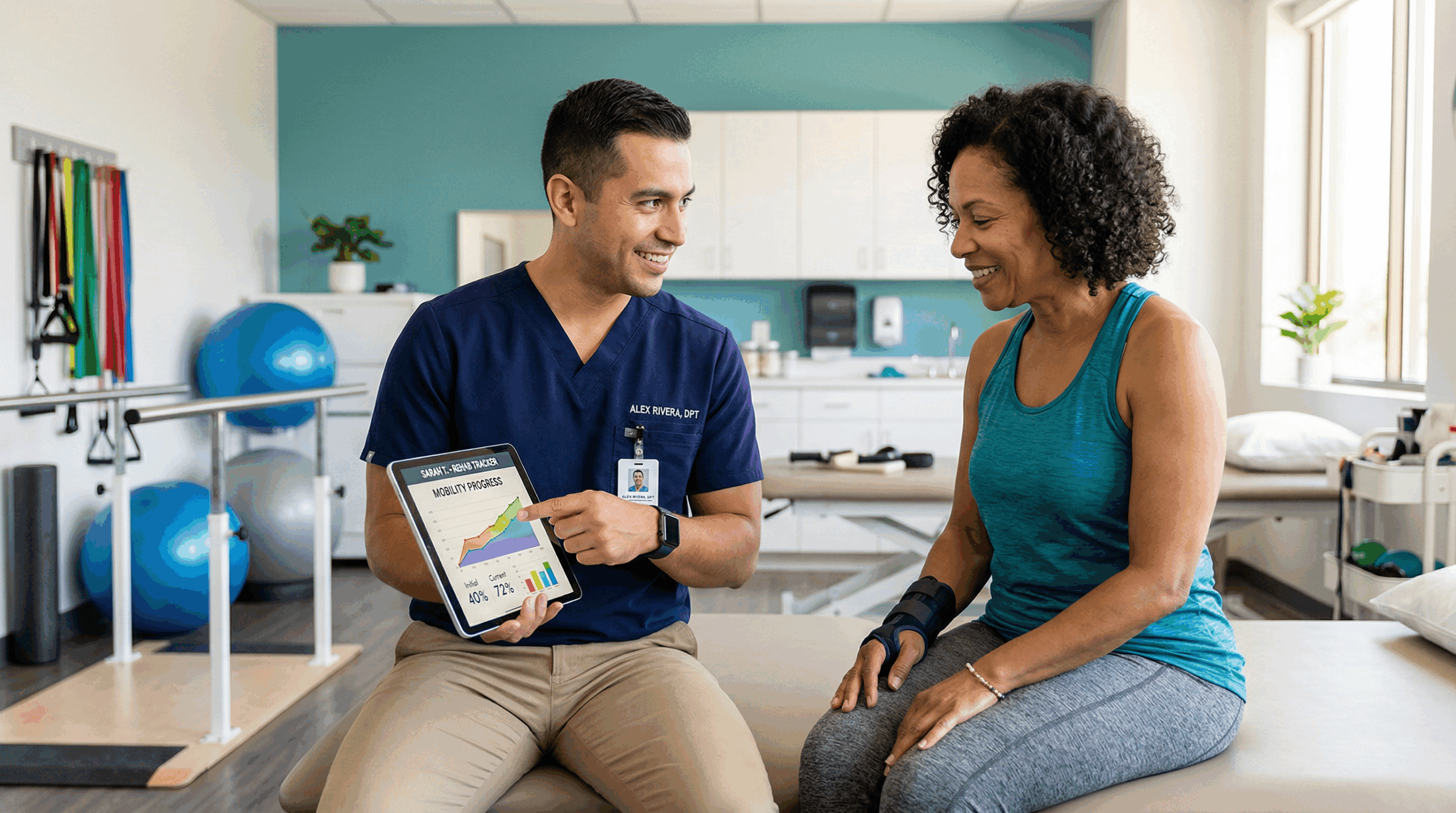
When a clinician can show a patient a chart demonstrating that their range of motion has increased by 30 degrees over four weeks, or that their grip strength has doubled since the initial evaluation, it provides tangible proof that the work is paying off. A study exploring patient and therapist perspectives on outcome measures found that patients consistently valued seeing objective results and felt encouraged by measurable changes in their function.
This is not a minor benefit. Patient engagement and compliance are among the strongest predictors of rehabilitation success. When patients can see their own data trending upward, they are more likely to stick with their home exercise programs, attend scheduled visits, and stay committed to the recovery process.
The Role of Digital Assessment Tools in Consistent Tracking
Consistency is what makes objective tracking reliable. If measurements are taken with different techniques, different equipment, or different levels of precision at each visit, the data loses its value. This is where digital assessment tools make a significant difference.
Calibrated digital dynamometers produce the same measurement regardless of which clinician operates them. Dual digital inclinometers eliminate the parallax error and estimating involved in visual goniometry. Algometers apply and record pressure with precision that manual palpation cannot replicate. When these instruments feed directly into a software platform, the data is automatically stored, timestamped, and organized into progress reports — eliminating transcription errors and saving documentation time.
The result is a clean, continuous record of the patient’s functional status that any clinician in the practice can interpret, and that stands up to scrutiny from insurers, attorneys, or peer reviewers.
Meeting Insurance and Documentation Requirements
Insurance carriers increasingly demand objective evidence of progress to authorize continued rehabilitation services. Medicare’s documentation requirements for physical therapy specify that progress notes must include objective measurements and functional outcomes tied to the treatment plan. Claims exceeding certain thresholds face targeted medical review, and notes that rely on subjective language alone are frequently flagged as insufficient.
Objective progress data directly addresses these requirements by providing:
- Baseline-to-current comparisons that demonstrate measurable change
- Functional outcome scores that show progress toward specific, documented goals
- Medical necessity justification supported by data showing the patient has not yet reached maximum improvement
- Discharge readiness indicators based on objective criteria rather than subjective judgment
When documentation is built on objective data, the conversation with insurers shifts from “why should we keep paying?” to “the data shows the patient is still improving and has not reached their functional goals.”
The Bottom Line
Objective progress tracking is not just good practice — it is the foundation of effective, defensible, and patient-centered rehabilitation. It gives clinicians the data they need to make better treatment decisions, provides patients with the motivation to stay engaged, and produces the documentation that insurers and legal professionals require.
The key is consistency: using calibrated digital instruments, collecting measurements at every visit, and tracking results in a unified software platform that makes the data easy to access and interpret. When rehabilitation progress is measured objectively, everyone involved — the clinician, the patient, the insurer, and the referring provider — can see exactly where the
Ready to make objective progress tracking part of every patient visit? Commander Echo delivers research-grade objective progress tracking, faster reimbursement, and stronger documentation across chiropractic, physical therapy, and occupational health practices.Whether you measure spine, extremity, or whole-body function, objective progress tracking with Echo turns every assessment into actionable insight. Adopt objective progress tracking today and give every patient a clearer path to recovery, every clinician sharper decisions, and every payer the evidence they require.
Categories & Tags
Evidence-Based Practice
Insurance Documentation
Progress Tracking
Objective Outcomes
patient rehabilitation
progress
rehab
rehabilitation
Neurological Cases
Medical Necessity
Functional Testing
Static Strength
Rehabilitation Cases
Pinch Testing
Goniometry
Grip Testing
Inclinometry
Range Of Motion
Muscle Testing
Physical Therapy
Functional Assessments