
The Role of Functional Capacity Evaluations in Return-to-Work Decisions
What Is a Functional Capacity Evaluation?
When an employee suffers a workplace injury, one of the most important questions everyone involved needs answered is: can this person safely return to work? A functional capacity evaluation (FCE) is designed to answer that question with objective, measurable data rather than guesswork.
An FCE is a comprehensive assessment — typically lasting four to eight hours — conducted by a licensed physical or occupational therapist. It measures an individual’s strength, endurance, range of motion, and ability to perform specific work-related tasks. The results are then compared to the physical demands of their job to determine whether they can return to full duty, need modified duties, or require ongoing restrictions.
For employers, insurers, attorneys, and treating clinicians, FCEs serve as a critical decision-making tool that bridges the gap between a medical diagnosis and real-world job performance.
Why Return-to-Work Decisions Need Objective Data
Return-to-work decisions carry significant consequences. Sending an employee back too soon risks re-injury and increased liability. Keeping them out too long drives up workers’ compensation costs and delays recovery. The challenge is that many return-to-work assessments rely heavily on subjective factors — the patient’s self-reported pain levels, a physician’s general impression, or an employer’s assumptions about job demands.
FCEs change that equation by introducing standardized, quantifiable measurements. According to a study published in the Journal of Occupational Rehabilitation, valid functional capacity evaluations provide objective measurements of work-related strength capabilities that support a medical provider’s opinion of a worker’s ability to return to work. When the data is clear, the decisions become more defensible — for everyone involved.
This matters not just clinically but legally. In workers’ compensation disputes and disability determinations, the strength of the evidence often determines the outcome. Objective FCE data is far harder to challenge than a physician’s subjective opinion alone.
What Gets Tested in an FCE
Each FCE is tailored to the individual’s injury and their specific job requirements, but the core components are consistent. A thorough evaluation typically includes:
– Material handling — lifting (floor-to-waist, waist-to-overhead), carrying, pushing, and pulling at various weight levels
– Positional tolerances — how long the individual can sit, stand, walk, kneel, crouch, or climb
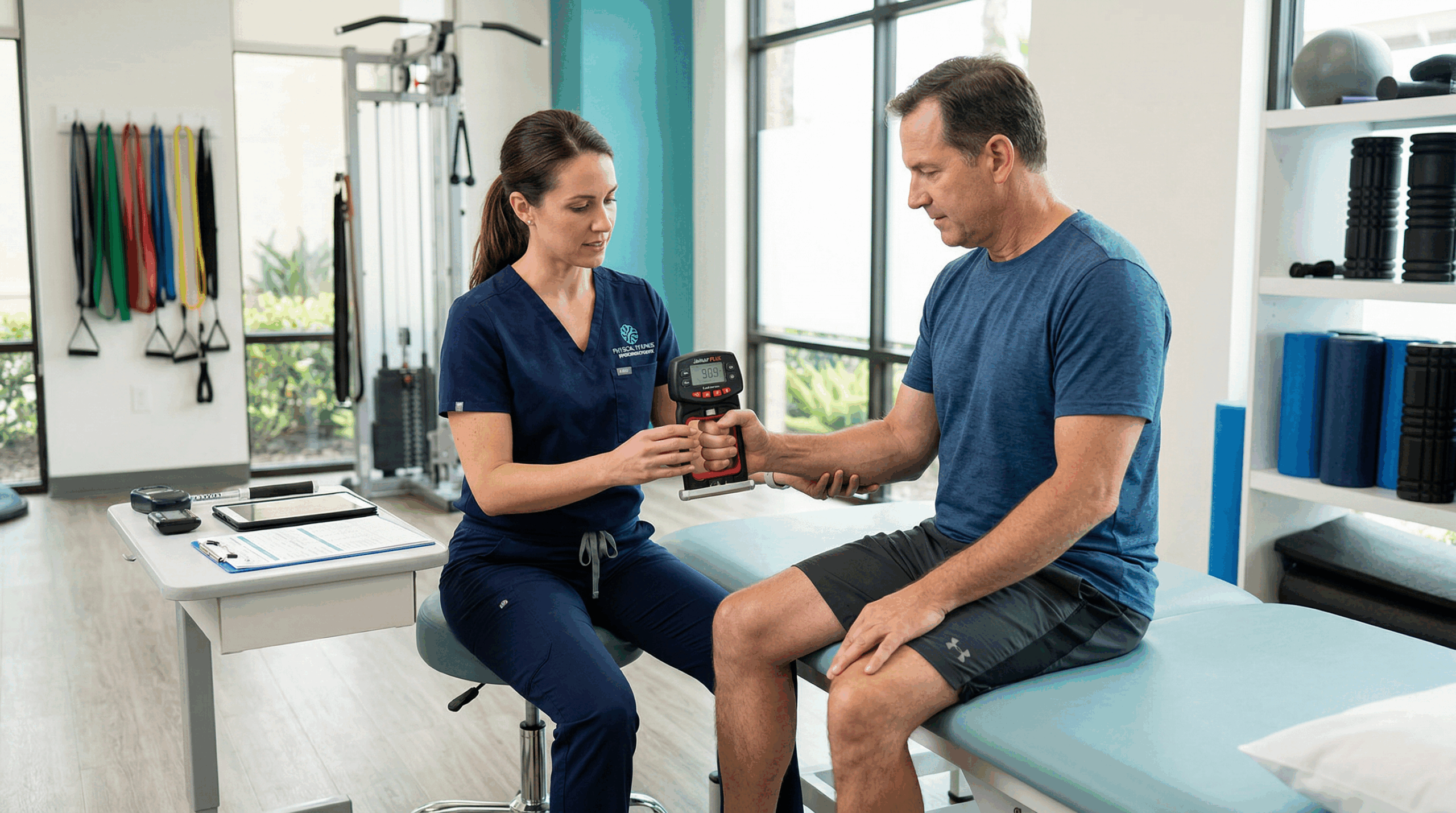
– Grip and pinch strength — measured with calibrated dynamometers to quantify hand function
– Range of motion — spinal and extremity mobility measured with inclinometers or goniometers
– Repetitive motion tasks — reaching, grasping, and fine motor activities relevant to the job
– Effort consistency — the evaluator monitors for signs of maximal versus sub-maximal effort throughout testing
The evaluator also reviews the patient’s medical and occupational history, observes pain behaviors, and compares test results against the physical demands of the job. The final report provides specific recommendations: return to full duty, modified duty with defined restrictions, or continued treatment before reassessment.
The Role of Digital Assessment Tools
The reliability of an FCE depends on the precision of its measurements. Manual assessments introduce variability — different clinicians may record different values for the same patient on the same day. Digital assessment tools solve this problem by providing standardized, repeatable measurements that are consistent across evaluators and sessions.
Calibrated digital dynamometers capture exact grip and pinch strength values. Dual digital inclinometers measure spinal range of motion with precision that manual goniometry cannot match. Algometers quantify pain pressure thresholds, turning a subjective complaint into a measurable data point. When all of these measurements feed into a unified software platform, the result is a comprehensive, defensible report that tracks the patient’s functional status from initial evaluation through discharge.
This level of precision matters because FCE results frequently end up in front of insurance adjusters, attorneys, and administrative law judges. Data captured by calibrated digital instruments carries more weight than hand-written estimates, and it is far more difficult to dispute.
Who Uses FCE Results and Why
FCE data serves multiple stakeholders across the workers’ compensation and rehabilitation ecosystem:
– Employers use FCE results to match a returning worker’s verified capabilities to available job tasks, reducing the risk of re-injury and ensuring compliance with accommodation requirements
– Insurance carriers rely on FCE data to validate claims, calculate settlement values, and determine when benefits should be adjusted or concluded
– Treating physicians incorporate FCE findings into their clinical decision-making, using objective functional data to supplement diagnostic imaging and physical examination findings
– Attorneys use FCE reports as evidence in workers’ compensation hearings, personal injury litigation, and disability proceedings — the more objective and well-documented the data, the stronger the case
– Case managers and vocational counselors use FCE results to guide job placement, modified duty planning, and long-term vocational strategies when a worker cannot return to their previous role
Best Practices for Defensible FCE Results
Not all FCEs carry equal weight. A poorly conducted evaluation with inconsistent methodology can be challenged and dismissed, undermining the entire return-to-work process. To produce defensible results, clinicians should follow established best practices:
– Use standardized protocols — follow recognized FCE guidelines to ensure consistency and reproducibility
– Document everything — record all measurements, observations, effort consistency indicators, and patient-reported information
– Use calibrated digital instruments — digital dynamometers, inclinometers, and algometers produce precise, repeatable data that holds up under scrutiny
– Compare to job demands — every FCE should be matched against a detailed job description or job demands analysis, not generic physical demand levels
– Track progress over time — serial FCE measurements create a functional recovery narrative that demonstrates whether the patient is improving, plateauing, or declining
– Assess effort consistency — document coefficient of variation and other indicators that demonstrate the patient gave maximal, reliable effort during testing
When these practices are followed, FCE results become a powerful, evidence-based foundation for return-to-work decisions that protect all parties involved.
The Bottom Line
Functional capacity evaluations are one of the most valuable tools in the return-to-work process. They replace subjective opinions with measurable data, give clinicians a clear picture of what a patient can and cannot do, and provide the objective evidence that employers, insurers, and legal professionals need to make informed decisions.
The key to getting the most out of an FCE is precision. Digital assessment tools, standardized protocols, and thorough documentation turn a good evaluation into a defensible one — and a defensible evaluation is what ultimately protects the worker, the employer, and the clinician alike.